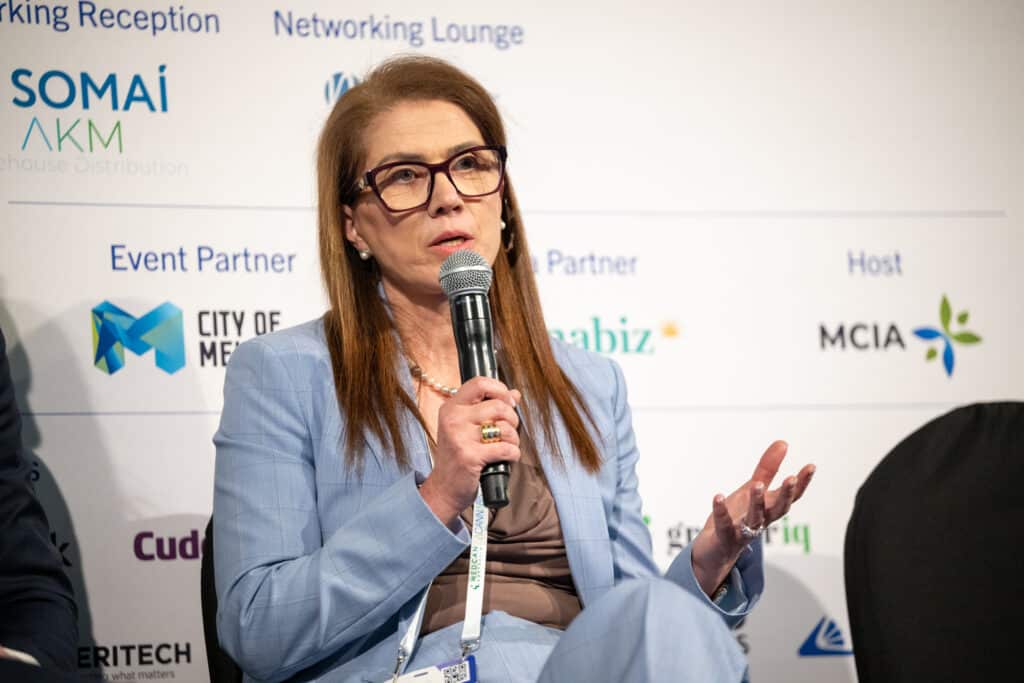
The organising team behind next month's United in Compassion conference has pushed back against criticism over the low number of female speakers in the program.
Dr Teresa Nicoletti, chair of the Australian Medicinal Cannabis Association (AMCA), said the committee — composed entirely of women — reached out to several female professionals for keynote roles, only to receive rejections due to prior commitments.
She also noted that the call for abstracts — the process through which conference content is selected — drew submissions that were predominantly from men.
Nicoletti's comments come in response to criticism raised by patient advocate and Viz Medicinal chief executive Natalie D'Alessandro.
In a LinkedIn post, D'Alessandro argued that the gender imbalance does not reflect any shortage of female expertise in the sector, but rather "appears to be a choice".
"Women are deeply embedded across research, clinical practice, regulation, cultivation, manufacturing, advocacy, and patient care," she wrote. "Many are internationally respected leaders. Their exclusion is not structural inevitability; it appears to be a choice."
She noted that the opening day "appears to feature an all-male speaker line-up" and pointed to a recent promotional image showing a panel that is 75% male.
"At some point in the planning process, someone should have paused and said 'this doesn't look right'. This line-up does not reflect the industry as it exists, the patient base it serves, or the values the sector frequently articulates," D'Alessandro wrote.
"As a seasoned event organiser, the process is straightforward. You review the program. You notice the imbalance. You invite women. That's it.
"There is still time for the conference organisers to address this imbalance. Doing so would not only improve the program; it would demonstrate how to uphold the very values the sector often claims."
Nicoletti said that the sector "remains male dominated" and that the committee's call for abstracts drew an overwhelming number of submissions from men.
The committee also attempted to bring additional international female experts to Brisbane, but those efforts fell through due to scheduling conflicts, including with psychedelics specialist Sue Sisley.
"The fair and equitable process was to publish a call for abstracts and unfortunately not many women submitted abstracts," Nicoletti said. "It's very difficult for us to say, well, we've got all these abstracts, now let's go out and find some women.
"If there is a suggestion that we have excluded women, it's just plain wrong.
"We want women to step forward and be part of the conference. You'll get no argument from me. There are other strong women in the sector who will support them if they want that."
Nicoletti also pointed out that a number of women are serving as moderators at the event, among them Fiona Patten, Sharon Bentley and potentially Clare Barker, while the nurses workshop is being led by women.
Women are also featured in the pharmacist's workshop and politicians panel, she added.
Bentley, CEO of MCA and a member of the organising committee, responded directly to D'Alessandro's LinkedIn post, writing: "Other female international speakers were invited but were unfortunately unable to attend. The [percentage] of male/female speakers currently in the program is a clear reflection of the responses received to the 'call for abstracts' for which we had an overwhelming response of mostly men.
"It would be great to have more women putting their hand up to be a part of these events. I am pleased to say there are a large representation of women on the AMCA Board and UIC organising committee."