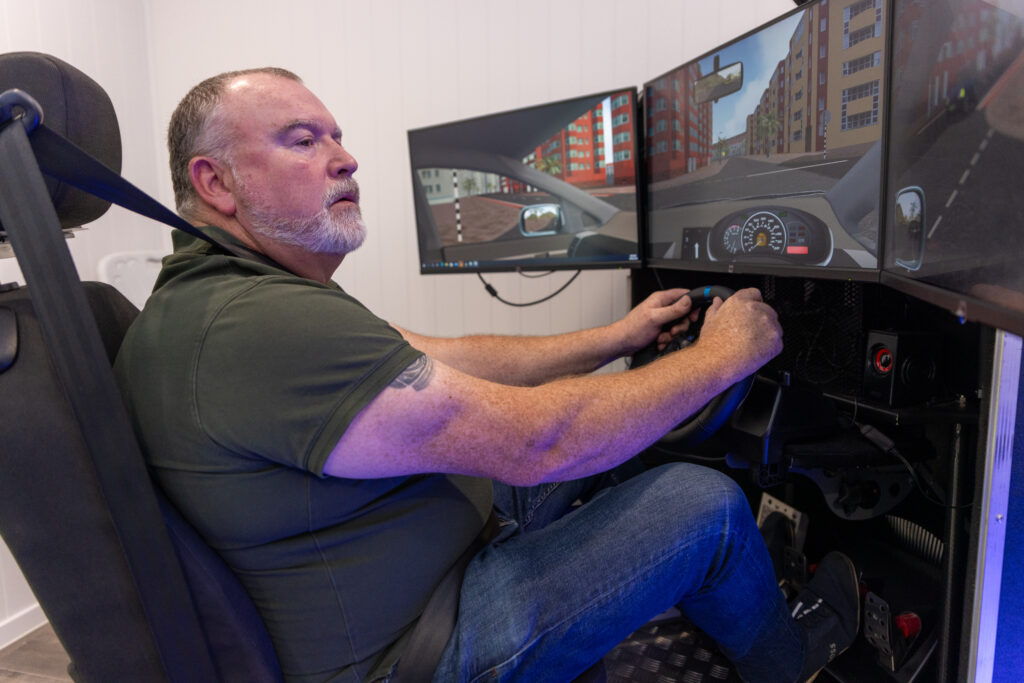
A supervised driving-simulator test broadcast on Channel 7 showed Medcan Australia director Gareth Ball posting a 20% faster reaction time after taking his prescribed medicinal cannabis.
The single-session trial, carried out at Driver Safety Australia in Queensland, measured Ball's performance before and after he consumed a 10/25 THC–CBD pastille prescribed to treat anxiety he has managed since adolescence.
Ball said the idea came from his desire to demonstrate the real-world effect of prescribed cannabis on his daily functioning and ability to drive.
He arrived at the test without having taken his medication, describing himself as "extremely anxious" — experiencing nausea and heightened nerves that hampered his first run.
"I get really bad anxiety generally – it makes me feel incredibly sick," Ball said.
"When I take my medication, it calms that down. I'm not getting high. I'm treating symptoms."
Roughly 30 minutes after dosing, Ball felt the "wave" of anxiety lift and went on to record better scores across braking and reaction assessments. On the reaction wall, he hit 42 coloured lights while medicated, compared with 35 before taking his medication — a 20% improvement.
He said the trial illustrated how medicinal cannabis supported his functioning relative to drugs he had previously been prescribed.
"Benzodiazepines, Tramadol, codeine, Endone – all of those impaired me far more than the cannabis medication I'm prescribed," Ball said.
The Medcan director acknowledged he was apprehensive about participating, calling it "a bit of a risk" to appear on camera without any certainty about how the results would turn out.
"But I knew in my heart of hearts how the medication affects me positively," he said.
Ball said he typically takes his dose at night, well before getting behind the wheel, but pointed out that patients can still return a positive roadside test long after medicating because cannabinoids are stored in body fat — unlike alcohol, which the body processes and clears quickly.
He argued that current saliva testing detects the presence of THC rather than actual impairment, drawing fresh attention to the uneven way Australia's states and territories handle THC driving laws.
Tasmania provides a legal defence for unimpaired medicinal cannabis patients who hold a valid prescription, while Victoria allows magistrates discretion not to cancel a licence — though in both states, driving with detectable THC remains an offence outside those specific provisions.
Ball questioned why a federally regulated medicine carries different consequences depending on which state a patient lives in.
"Why is a Victorian patient treated differently to a Queensland patient?" he said.
He also said he would be prepared to repeat the test on a controlled track to help move the conversation forward.