The Australian Medical Association (AMA) has formally opposed the Greens' adult-use cannabis bill, asserting it would increase youth cannabis consumption. Yet the body's submission relies on evidence that does not support its conclusions, writes honahlee co-founder Will Rayner.
The AMA's submission to the Senate inquiry into the Greens' legalisation bill offers a textbook example of how to present evidence in a misleading way.
From the outset, it builds a strong case against legalisation, pointing to alleged harms observed in overseas markets.
Among its central claims: that since Canada legalised cannabis, youth consumption rates have risen, as have emergency department visits and diagnoses of cannabis use disorder.
While I — along with honahlee — support legalisation, a genuine rise in youth cannabis consumption would be a serious concern, and any future Australian framework would need to address it carefully.
Even so, the AMA's assertions ran counter to what I had read about the Canadian experience, which prompted me to examine the citations in its submission.
The first study cited does not actually measure youth cannabis consumption rates. It surveys the perceptions of mental health service providers in Ontario. Provider opinions have value, but they are not empirical data and should not be presented as such.
The second source, however, says the opposite of what the AMA asserts:
"Since 2019, recent cannabis use in Canada has modestly increased among adults but not among adolescents."
The AMA references the author of that second source, Emeritus Professor Wayne Hall, four times throughout its submission — making it all the more puzzling that it directly contradicts the very work it cites.
When I contacted Professor Hall to ask about his work being used in this way, he responded:
He said: "The AMA has long opposed cannabis legalisation, so it is not surprising that they focus on my work on possible health-related harms of legalisation. If I tried to correct the selective citation of my publications on cannabis I would get nothing else done."
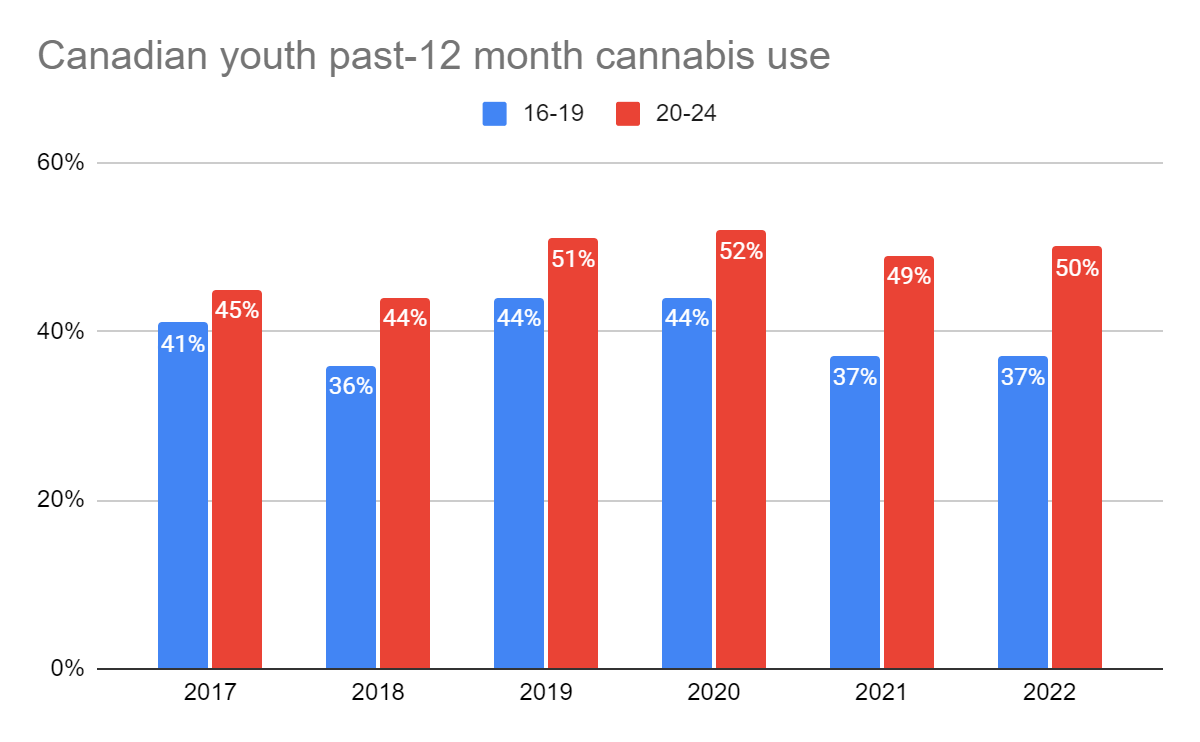
The Canadian government has conducted its own direct population surveys, and that data does not show the rise in youth consumption the AMA claims.
On the contrary, it shows youth consumption currently sitting below pre-legalisation levels. Anyone can examine the figures via this link.
I contacted the AMA to ask precisely which evidence underpins its claim.
A representative directed me to a claim in the mental health provider survey study (Kourgiantakis et al., 2023).
"Since legalisation came into effect, the rates of cannabis use in Canadian youth have increased." [4,5,6,7,8,9]
On the surface the claim looks well-supported, backed by six additional citations. The AMA's response also acknowledged that some of this increase had been attributed to COVID-19.
A statement implying that legalisation drove up youth consumption seemed an odd place to cite COVID-19 research, so I examined each of the six references in turn.
Of those six citations:
- Two report a modest increase in youth consumption (4,5)
- Two show a decline in youth consumption (6,8)
- One documents a general increase across the US and Canada, but notes the rise was consistent regardless of whether cannabis was legal (7)
- One is an online survey of approximately 300 people aged 18 to 29 who were already cannabis consumers, conducted six weeks into the COVID pandemic and asking them to reflect on how their use had changed since legalisation (9)
- None of the six attribute any change in youth consumption trends to legalisation.
Full details and links to each citation appear at the end of this piece.
Across its submission, the AMA has:
- Cited sources whose findings contradict its own claims
- Disregarded evidence that undermines its position.
It is hard to see this as the conduct of a body genuinely focused on Australian public health outcomes. It looks more like an organisation searching for any evidence that supports a conclusion it has already reached.
Cannabis prohibition in Australia will end eventually. It probably will not be the Greens' Legalising Cannabis Bill 2023 that brings it about, but the direction of travel is clear.
Given how late Australia is to act, the country will face significant policy pressure from large international adult-use cannabis companies when the time comes.
If the AMA persists in misrepresenting the evidence, it will forfeit any credibility in future debates about cannabis regulation.
Citations from the AMA submission
The research draws on COMPASS study data from the 2016/17 and 2017/18 school years, plus one year after legalisation (2018/19).
The abstract of the study reads: "Youth cannabis use remains common with ever-use increasing from 30.5% in 2016/17 to 32.4% in 2018/19. In the repeat cross-sectional sample, the odds of ever use in the year following legalisation were 1.05 times those of the preceding year (p=0.0090). In the longitudinal sample, no significant differences in trends of cannabis use over time were found between cohorts for any of the three use frequency metrics. Therefore, it appears that cannabis legalisation has not yet been followed by pronounced changes on youth cannabis use."
The data shows a 1.9% rise over three years, with no significant differences in trends.
Drawing on the same COMPASS dataset, this study uses only data from 2017–2018 and 2018–2019.
Its focus is on the modes of cannabis consumption among youth, and it makes no claim about broader trends across Canada.
"This study has some limitations to note. First, it used purposive sampling, and as such results are not generalizable to all Canadian youth…"
Conducted in mid-2020, this study examines the impact of COVID-19 on substance use and has no bearing on the effects of legalisation.
The findings do not show more youth consuming cannabis — the number actually fell.
"For most substances, the percentage of users decreased; however, the frequency of both alcohol and cannabis use increased."
7. Prevalence and modes of cannabis use among youth in Canada, England, and the US, 2017 to 2019
An online survey spanning the US, Canada, and the UK.
When it comes to Canadian legalisation, it reaches a similar conclusion to the initial COMPASS analysis: "The extent to which the increases observed among youth in Canada are the result of non-medical cannabis legalisation is unclear, given that similar increases were observed in the year prior to legalisation (2017 to 2018), as the year following legalisation (2018 to 2019)…"
The US findings are also notable: "A supplementary analysis between US states that had and had not legalised recreational cannabis found no differences in 2019 for prevalence of cannabis use in the past 12 months or past 30 days…"
8. Changes in youth cannabis use after an increase in cannabis minimum legal age in Quebec, Canada
This is not a study on the effects of legalisation. Instead, it examines what happened when Quebec raised its legal purchase age in January 2020, long after legalisation had already taken effect.
The results are unsurprising: "In this study, the increase in Quebec's cannabis MLA from 18 to 21 years was associated with a significantly lower increase in cannabis use among youths aged 18 to 20 years in Quebec than in other provinces."
This finding cuts directly against the AMA's position — legalisation was precisely what gave Quebec the power to set a minimum purchase age in the first place.
The study surveyed 312 individuals who:
- Had smoked and/or vaped cannabis in the preceding 12 months
- Resided in Canada
- Were between 18 and 29 years of age
Conducted in 2020, the survey asked participants to reflect on their cannabis use prior to COVID-19 and prior to legalisation.