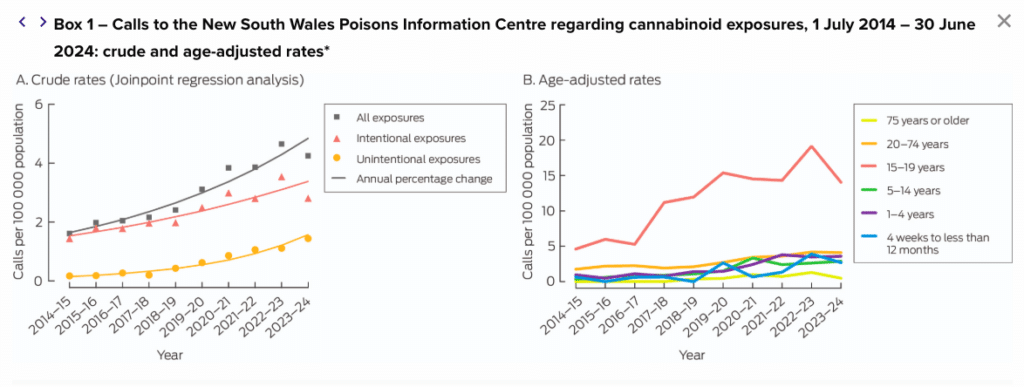
Reported cannabis poisonings in Australia have climbed steeply over the past ten years, yet researchers have stopped short of attributing the rise to the legalisation of medicinal cannabis.
Researchers at the University of Sydney examined data from the New South Wales Poisons Information Centre (NSWPIC), which handles approximately half of all calls made to Australian poisons information services. Of those calls, 65% originated in NSW, with the remainder coming from other states.
The dataset covered the period from July 2014 to June 2024.
Over that decade, the NSWPIC logged 3,796 calls related to cannabis poisoning, with call volumes growing at a rate of 12.8% annually. Males accounted for 54% of cases and females for 46%.
In 3,184 cases (84%), the person who had been exposed was already showing poisoning symptoms when the call was made, and 2,783 people (74%) were either already in hospital or were directed there following the call.
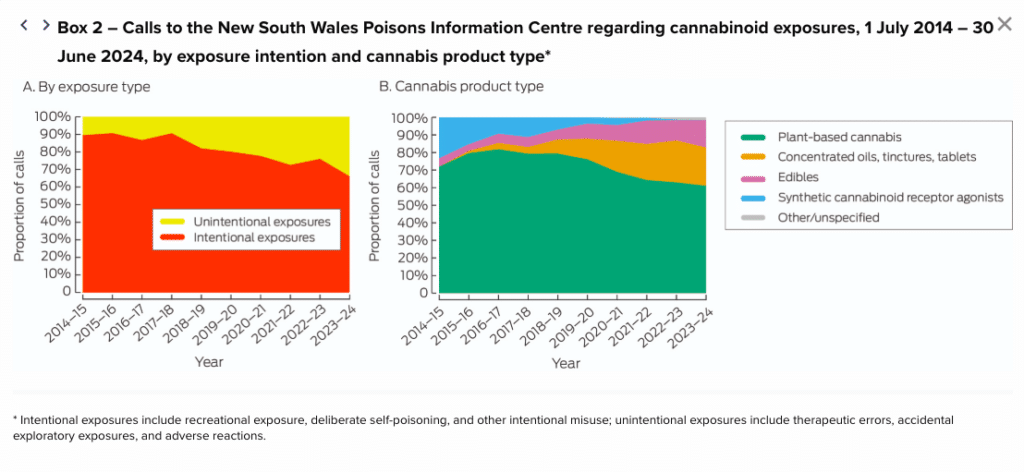
Intentional exposures — covering recreational use, deliberate self-poisoning, and other wilful misuse — were recorded in 2,981 calls (79%), rising by 9.2% per year. Unintentional exposures — including therapeutic errors and accidental ingestion — accounted for 815 calls (21%), but grew far more quickly, at 30% per year.
The age-adjusted poisoning exposure rate was highest among 15- to 19-year-olds, at 11.4 calls per 100,000 people per year. For unintentional exposures, toddlers aged one to four had the highest age-adjusted rate, at 1.9 calls per 100,000 population.
Plant-based cannabis — flower or leaf — was the exposure type recorded in 2,663 cases (70%), though its share of total calls dropped from 72% in 2014–15 to 61% in 2023–24.
The proportions involving concentrates and edibles both grew over the same period — concentrates rising from zero to 124 calls (22%), and edibles from nine calls (5%) to 88 (16%).
Among unintentional exposure calls across the decade, concentrates were involved most often (320 calls, 39%), followed by plant-based cannabis (302 calls, 37%) and edibles (171 calls, 21%).
Calls about edible products have accelerated sharply since 2019–20, with gummy or lolly-style edibles featuring prominently — all 89 cases involving that form were recorded after 2019–20.
Despite the clear upward trend, the researchers were unable to pinpoint a definitive cause — including medicinal legalisation — and suggested the increase may instead reflect broader social acceptance of cannabis and greater access to edible products.
They wrote: "The increase in exposure calls could… reflect a steady increase in cannabis use during 2014–24 because of changing social norms and perceptions of cannabis safety and legality.
"The more rapid increase in calls about exposures in young people could reflect the increasing availability of edible forms, which can be medically prescribed or obtained illicitly.
"This interpretation would be consistent with survey findings that about 15% of Australians who used cannabis for medicinal purposes used oral formulations in 2016 (prior to its legalisation), but 33% did so in 2022–23."
The researchers noted that while cannabis is "widely believed" to be safe in overdose, "it can cause central nervous system (CNS) excitation, CNS depression, hallucinations, psychosis, and cardiac dysrhythmias".
They added: "The risk of severe toxicity is greater for children, in whom it can lead to apnoea and coma; in one US study, 32 of 60 children (aged 0–10 years) hospitalised with cannabis intoxication required intensive care."
The team also cited American research documenting increases in poisoning cases following both medicinal and recreational cannabis legalisation, with children particularly affected.
"Edibles are particularly high risk products because of their palatability and the possibility of large ingestions," they said.
The researchers acknowledged several limitations, including the fact that the NSWPIC does not routinely conduct follow-up enquiries, the relatively small size of the dataset, and its reliance on self-reporting.
Some cases also involved exposure to more than one substance.