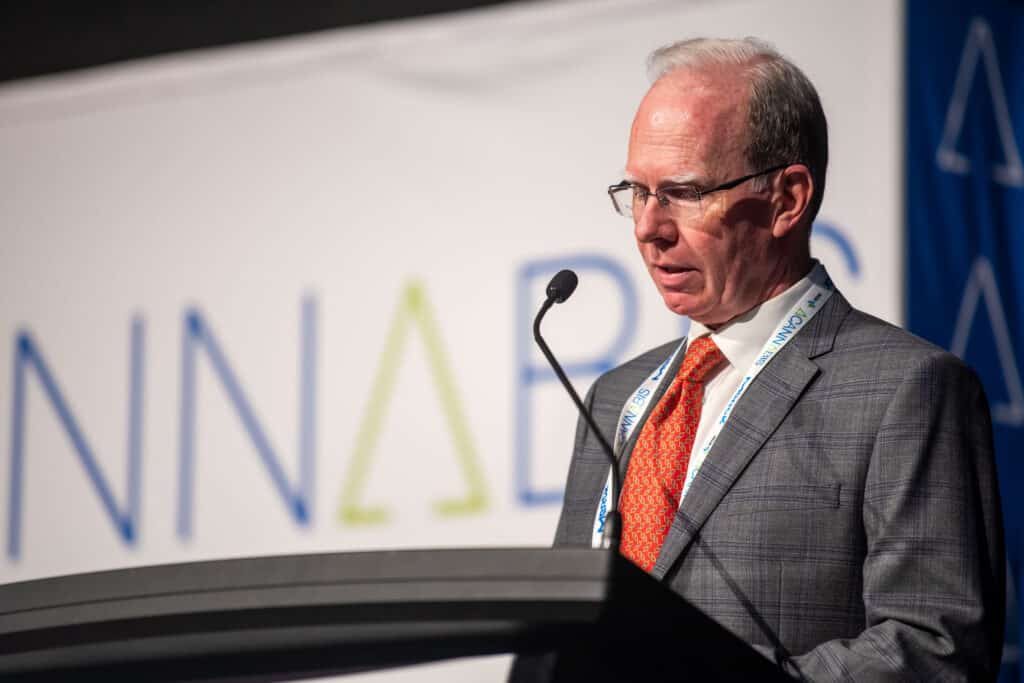
Australian cultivators with high-quality product can still win in the competitive German medicinal cannabis market, but patients won’t care where it comes from, delegates at the ACannabis conference have heard.
Materia managing director Nick Pateras said Australian companies looking to build a European strategy must focus their attention on a market which has roughly doubled in size every year since 2017.
“Markets one, two and three are Germany, Germany and Germany. It’s the biggest market by far and also the fastest growing.
“So if you really want to win, you have to win in Germany. Of course, it’s also very competitive.”
Materia is a European-focused processor and distributor of medicinal cannabis with an EU-GMP production facility in Malta and a German distribution arm.
While acknowledging there is oversupply in Germany, Pateras said: “What there isn’t is an oversupply of high-quality product.
“There’s a mushy middle, homogeneous products that really don’t have a point of differentiation, and are not considered anything special by patients.”
Despite the growing popularity of extracts, Europe remains predominantly a flower market according to Pateras, with high-volume patients using it multiple times each day to treat chronic conditions.
He said this group was the most important to win over, given their prolific use of social media.
“They’re the social influencers among the patient groups. Someone who is really engaged with the category. They’re often on Facebook groups or Reddit forums, writing product reviews and talking with their friends.
“High-quality flower is where you win.”
Pateras added the extracts market in Germany, while competitive, suffers from a lack of differentiation and difficulties with patient access, making it hard to turn a profit.
“There’s a lot of white labelling going on… brands fighting for share when they really have the same product with a different logo on the tin.
“For flower, you can go through patients. You try to win the patient, who then initiates the conversation with a doctor.
“But with extracts, you have to go to the doctor. And that is a really expensive endeavour. You need a proper pharmaceutical sales team.
“So to invest in that and for the return you’ll see, extracts is definitively a non-profitable segment… probably for quite some time.”
After Germany, Pateras identified Italy as the second largest European market by volume, though hard to access, while Holland - despite a long history of medicinal cannabis use - remains difficult to break into due to Bedrocan’s strong presence.
The UK, he said, is English speaking and offers access to capital, but remains a small, early-stage market where strict patient access rules make product prohibitively expensive.
Despite Australia’s climate and reputation for high-quality agricultural output, Pateras pushed back on the idea that companies should band together to build a ‘Brand Australia’ presence in Europe.
“Candidly, I don’t think a German patient really cares where their cannabis is grown,” he said.
While there may be a “novelty aspect” around cannabis from different countries, Pateras insisted quality will ultimately be the deciding factor.
“We saw the first product come from Jamaica to Germany last summer and there was a little bit of hype around it… You might find some patients who are curious to try it for the sake of exploration.
“Patients may do that once, but fundamentally, quality will win over anything else.
“So to try to point to the fact that you are Australian, I don’t think it’s a long-term competitive advantage.”